The Developing Virginia’s Talent committee is connecting credentials to careers — and nearly 50,000 Virginians still working in the Commonwealth are proof.
By Jean Runyon and Catherine Finnegan
Craig Butterworth contributor
This is the second installment of our 5-part series on Accelerate Opportunity – the VCCS strategic plan. Here, we zoom-in on our programs and how they’re being fine-tuned to accommodate the needs of employers statewide.
Figgers
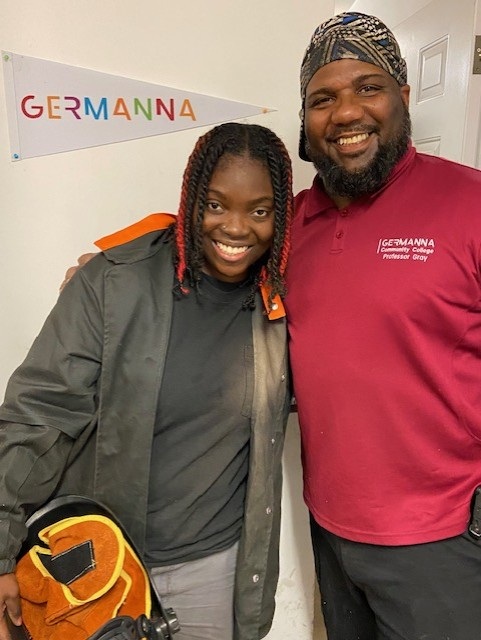
In September, Tinasha Figgers enrolled in the Welding Level 1 program at Germanna Community College. She was 22 years old, working part-time at Wawa for about $200 a week, living with her grandmother, and attending welding classes at night. She knew she wanted something different. She just needed a way in.
FastForward funding covered the majority of her training costs, removing the financial barrier that stops many students before they start. A few months later, Figgers was hired as a welder at Cochrane USA — earning $1,500 a week for 40 hours, with opportunities for up to 20 additional hours of overtime. She has already committed to returning for Welding Level 2.
“Our goal is to make sure students don’t just graduate — they transition directly into the field. Tinasha put in the work, and this opportunity is well-earned.”
— Professor Saxon Gray, Welding Instructor, Germanna Community College
Figger’s story is playing out across Virginia at a scale that is easy to underestimate. Since 2017, nearly 50,000 FastForward completers are still working in Virginia — in healthcare, logistics, skilled trades, IT, and beyond — having collectively earned more than $2.1 billion in wages in 2024 alone. None of that happens without sustained, deliberate work to ensure that the credentials Virginia’s community colleges award are genuinely connected to what Virginia’s employers need. That’s the mission of the Developing Virginia’s Talent committee, led by Dr. Greg Hodges, president of Patrick & Henry Community College.
What Completion Actually Changes
Tinasha’s jump from $200 to $1,500 a week is dramatic, but it isn’t an outlier. The wage data from last year’s G3 graduates tells a consistent story: students who completed their credential went from a median wage of $22,054 before enrolling to $43,808 after completing — nearly doubling their earnings. For students who started below the federal poverty line, median wages more than doubled, from $16,816 to $36,994. Skilled trades completers — students like Tinasha — saw median wages rise from $20,674 to $41,912.
Perhaps the most telling figure is the gap between students who finished and those who didn’t. Completers earned a median post-credential wage of $43,808 — compared to $31,230 for students who enrolled but did not complete. That $12,578 difference is why the committee’s work on completion support — including a CompTIA pilot bringing credentialing specialists to five colleges through Dell grant funding — matters as much as the work on program alignment. Germanna’s model of connecting students to employers at the halfway point of training is exactly the kind of practice the committee is working to understand, document, and scale.
“When you see a student go from $200 a week to $1,500 a week, that’s not just a number — that’s a family’s future changing. That’s what workforce alignment actually means. It means the credential we’re awarding connects to a real job, at a real wage, in a field Virginia actually needs. That’s the standard we hold ourselves to, and that’s what this committee’s work is designed to ensure.”
— Randy Stamper, Associate Vice Chancellor for Workforce Programs, VCCS
Pointed in the Right Direction
Wage outcomes tell half the story. The other half is whether the system’s programs are aligned with where Virginia’s labor market is actually heading. The evidence is encouraging. Health professions account for 32% of G3 completions — a direct response to Virginia’s acute healthcare workforce needs. Construction trades completions are nearly perfectly matched to labor market demand. Computer and IT programs are similarly well aligned. These aren’t coincidences — they reflect years of deliberate program development guided by labor market data, and a committee that keeps asking whether the system is keeping up.

Virginia G3 logo
In March, the State Board for Community Colleges formalized that work, officially approving the G3 program listing as the standard for identifying high- demand fields — giving colleges a stable, consistent foundation to plan around. That decision was strengthened further when the Virginia Office of Education Economics released an updated review of eligible program codes in February, keeping the definition connected to where Virginia’s economy is heading.
“Peppered throughout the metrics associated with the Developing Virginia’s Talent objective are phrases like meaningful post-secondary credentials, regionally high-demand fields, and VCCS graduates who achieve upward mobility. The intent is simple: ensuring that colleges are delivering and consistently measuring credentials that bring labor market value and provide economic gains to all students. Frankly, it’s why we open our doors every day.”
— Dr. Greg Hodges, President, Patrick & Henry Community College, and Chair, Developing Virginia’s Talent Committee
Two more welding students from Germanna have interviews scheduled with Cochrane USA. That pipeline — from classroom to career, replicated across programs and colleges throughout Virginia — is what the Developing Virginia’s Talent committee is working to make the rule rather than the exception. Nearly 50,000 FastForward completers still working in Virginia, $2.1 billion in wages earned in a single year, 29,125 employers who have hired them — the scale of what’s already been built is remarkable. The work now is making sure every student who walks through the door has the same shot Tinasha had.

Fast Forward logo
BY THE NUMBERS
49,650 FastForward completers still employed in Virginia (through June 2025)
$2.1 billion earned by FastForward completers working in Virginia in 2024 alone
29,125 unique Virginia employers have hired FastForward completers
$22,054 → $43,808 Median wage change for G3 completers
$16,816 → $36,994 Median wage change for G3 completers who started below the poverty line
NEXT ISSUE
Issue 3 — Reaching More Virginians: Who isn’t here yet, and what is the system doing about it? We go inside the Adult Readiness Assessment and the regional marketing campaigns designed to bring more working adults back to education.
Accelerate Opportunity 2030 • Virginia Community College System • vccs.edu

